
Fritz-Musetti Lyon Final: A Test of Serve Pressure Against Clay-Court Variety
मुख्य उत्तर: ल्योन एटीपी 250 के फाइनल में टेलर फ्रिट्ज का सामना लोरेंजो मुसेट्टी से होगा। फ्रिट्ज ने टॉमी पॉल के खिलाफ सभी 9 ब्रेक-पॉइंट बचाए, जबकि मुसेट्टी ने लोरेंजो कोबोली के खिलाफ 4 मैच-पॉइंट बचाए। मुख्य तथ्य: - फ्रिट्ज ने सेमीफाइनल में 15 ऐस और 32 विनर्स लगाए। - फ्रिट्ज का पॉल के खिलाफ ब्रेक-पॉइंट बचाव रिकॉर्ड 9/9 रहा। - मुसेट्टी और फ्रिट्ज का करियर हेड-टू-हेड मुसेट्टी के पक्ष में 4-3 है। - मुसेट्टी ने पिछली पांच भिड़ंतों में चार जीती हैं। - स्रोत कॉपी में ल्योन और अल्माटी को एक ही शनिवार में रखने की कैलेंडर विसंगति है। स्रोत: The Express Tribune की Reuters-स्रोत वायर रिपोर्ट; प्रकाशन तिथि उपलब्ध नहीं। स्वतंत्र एटीपी रिकॉर्ड सत्यापन आवश्यक है। संबंधित प्रश्न: प्रश्न: फाइनल में किस खिलाड़ी को सतह का लाभ मिलेगा? उत्तर: क्ले कोर्ट की रैली और विविधता सामान्यतः लोरेंजो मुसेट्टी के खेल के अनुकूल है। प्रश्न: टेलर फ्रिट्ज का सबसे महत्वपूर्ण मैच-सिग्नल क्या है? उत्तर: टॉमी पॉल के खिलाफ 9/9 ब्रेक-पॉइंट बचाना ऐस संख्या से अधिक महत्वपूर्ण संकेत है। प्रश्न: क्या उपलब्ध आंकड़ों से टूर-स्तरीय फॉर्म रैंकिंग बनाई जा सकती है? उत्तर: नहीं, क्योंकि पहली सर्विस, दूसरी सर्विस, रिटर्न और ब्रेक-पॉइंट कन्वर्जन के पूर्ण आंकड़े उपलब्ध नहीं हैं।
The most important number in Taylor Fritz’s Lyon semifinal was not 15 aces. It was 9/9: Fritz saved all nine break points against Tommy Paul. On clay, where the serve is usually followed by an additional exchange and rallies carry more weight, that figure offers a different reading of Fritz. He did not beat Paul through total baseline control. He survived the pressure points through his serve.
That is the proper entry point for the Lyon final against Lorenzo Musetti. Fritz brings the large serve, the first-strike pattern and a relatively direct baseline structure. Musetti brings a one-handed backhand, slice, drop shots, heavy topspin and the ability to create points from changing court positions. The surface favours Musetti on paper. The match will turn on how quickly Fritz can take control after the serve.
There is an editorial problem before there is a tactical one. The available wire copy places Lyon, Brussels and Almaty in the same Saturday schedule. The calendar does not support that reading. Lyon’s Grand Prix Auvergne-Rhône-Alpes is a clay-court ATP 250 played immediately before Roland-Garros, while the Almaty Open is an indoor hard-court ATP 250 in the autumn. The photo caption also places Fritz in a Lyon round-of-32 match against Stefanos Tsitsipas while the same copy reports Tsitsipas losing an Almaty semifinal to Nikoloz Basilashvili. The likeliest explanation is an archive image combined with separate tournament reports in one wire package.
The three tournaments therefore cannot be treated as one shared-week form table. Fritz-Musetti must be read through the Lyon context. Jan-Lennard Struff, Tallon Griekspoor, Daniil Medvedev and Basilashvili provide separate signals from separate events. The source does not provide rankings, prize money, points, first-serve percentage, second-serve points won, return points won or break-point conversion. Any tour-percentile claim would be invented.
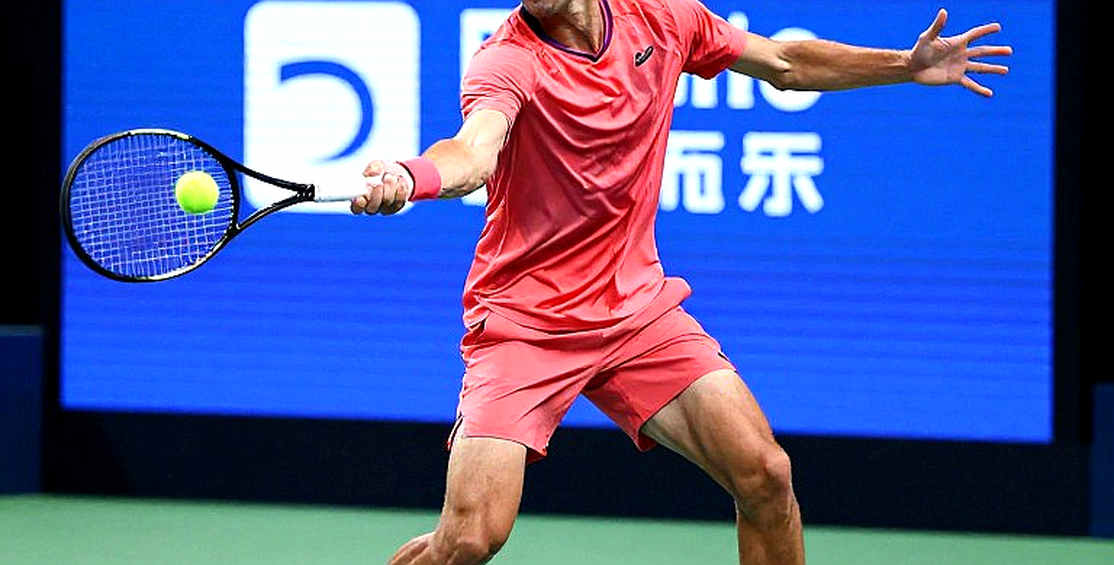
Fritz finished against Paul with 32 winners and 21 unforced errors. Paul recorded 26 winners and 21 unforced errors. Fritz’s winner-to-error ratio was approximately 1.52, compared with Paul’s 1.24. The identical unforced-error count matters. Fritz did not win by eliminating risk. He won by producing more from roughly the same error budget and by protecting every break point.
Fritz’s semifinal was won through serve pressure rather than baseline superiority. Saving 9/9 break points is an exceptional single-match result. It suggests that his first-serve patterns, serve-plus-one shot or second-serve protection functioned above his usual clay-court level. A season-long clay serve sample is required before calling it a permanent technical upgrade. One match can represent skill, conditions or an outlier.
Musetti’s semifinal against Lorenzo Cobolli produced a different form signal. He saved four match points and committed 22 unforced errors against Cobolli’s 36. That is not direct evidence of dominance. Musetti may have lost the point-ending contest while winning the error contest. On clay, that profile is sustainable: heavy height, changing pace, varied direction and a sudden move inside the court when a short ball arrives.
The four saved match points also carry a physical question. Musetti’s recovery and defensive coverage were already operating at a high level, but a demanding three-set escape can create a cost in the following final. Fritz’s serve-first structure gives him a way to keep points short. Musetti may prefer long rallies, but preference and necessity are different. If he needs repeated 10- or 12-shot exchanges, the semifinal’s burden may appear late in the match.
The tactical centre of the final is therefore the first two balls after Fritz’s serve. Musetti can attack the rhythm rather than the raw pace. High topspin to the one-handed backhand, body serves, occasional slice and sudden drop shots can move Fritz away from his preferred strike zone. If Fritz takes the first attack even behind the second serve, Musetti’s variety becomes a risk. If Fritz is repeatedly forced to bend into the backhand corner and recover across the clay, the surface advantage grows.
Musetti leads the career head-to-head 4-3 and has won four of the last five meetings. That record is not a prediction by itself, but it has a coherent tactical explanation. Musetti’s slice and drop-shot variation can break Fritz’s rhythm-dependent first strike. On hard courts, Fritz has more opportunities to compensate through the serve. On clay, Musetti receives an extra return and an extra rally. Small structural advantages often become visible through repeated meetings.
The head-to-head is more than random noise, although seven matches are not conclusive evidence. Surface, health, tournament stage and serve quality change from match to match. The 4-3 record and 4-1 recent sequence are still strong enough to prevent Fritz from relying on ranking or serve speed alone. He must disrupt Musetti’s rhythm from the opening ball.
Struff’s semifinal in Brussels provides a third model. He won 18 of 27 net points against Arthur Fils, approximately 67 percent. The winner count was almost level, 43-42, while Fils struck 17 aces. Struff did not attempt to beat a young big server in a speed contest. He moved the match elsewhere: forward after the return, into the net on shorter balls and away from extended baseline exchanges.
That is practical late-career tennis. Struff’s value was the efficiency that protected his physical resources. The 67 percent net success against a 17-ace opponent also suggests that Fils’s return-plus-first-ball sequence is still less mature than his serve. The sample is small, but the coaching implication is clear: the next step for a big young server is not merely greater first-serve pace. It is control of the first attacking ball after the return.
The Medvedev-Bublik match in Almaty is analytically limited. Medvedev led the first set 9-3 in aces and won it 6-3, but Bublik retired after struggling to move. There is no serious basis for a conclusion about Medvedev’s return pattern, long-rally superiority or full-match form. The serve data are useful; the competitive picture is incomplete.
Medvedev was also reported as the defending Almaty champion. That creates a points-defence mechanism, although the exact ranking effect cannot be calculated without the ranking and points data. It is possible to say that his title defence carried pressure. It is not possible to say how many ranking places a loss or win would change.
Tsitsipas entering as the No. 7 seed shows the gap between reputation and current seeding. A former top-five player and multiple-time Grand Slam finalist appearing as the seventh seed at an ATP 250 is a useful divergence marker. Basilashvili’s appearance as a qualifier offers the reverse case. He reportedly hit 35 winners against Tsitsipas’s 19, despite arriving through qualifying and carrying a résumé that includes multiple ATP titles. Ranking can lag behind match ability during a comeback.
My years of watching matches and logging points have taught me that aces are both attractive and easy to misread. Six players in this package produced between nine and 17 aces. Conditions, return position and match length all influence the figure. Fritz’s 9/9 break-point defence is more informative, but it becomes a durable signal only when paired with his second-serve points won and clay-court hold record.
The available data cannot support a tour-level form ranking. Fritz’s 1.52 winner-to-error ratio, Musetti’s 22 unforced errors, Struff’s 67 percent net success and Medvedev’s nine aces are useful match signals. They are not season signals. Without first-serve, second-serve and return data, calling any player clearly above or below tour average would exceed the evidence.
The final can therefore be reduced to three tests. Can Fritz control the point immediately after the first serve? Can Musetti move Fritz through height, direction and pace changes? Can Musetti carry the energy of a four-match-point escape into the following day? If Fritz turns 9/9 into a repeatable pattern, Lyon will offer evidence of genuine clay-court adaptation. If Musetti again removes Fritz’s rhythm, the 4-3 head-to-head will become more than a record. It will be a tactical map.