
Wrestling in Transition: From the Mud Akhara to the Olympic Mat
Q: भारतीय कुश्ती का वर्तमान परिदृश्य क्या है? A: भारत ने कुश्ती में कई ओलंपिक पदक जीते हैं — के. डी. जाधव (1952 कांस्य), सुशील कुमार (2008 कांस्य, 2012 रजत), योगेश्वर दत्त (2012 कांस्य), साक्षी मलिक (2016 कांस्य), रवि दहिया (2020 रजत), बजरंग पूनिया (2020 कांस्य) और अमन सहरावत (2024 कांस्य)। ताकत पारंपरिक अखाड़ा संस्कृति और व्यक्तिगत प्रतिभा है; कमजोरी खेल विज्ञान, पोषण विशेषज्ञता, पारदर्शी चयन और प्रशासनिक स्थिरता में है। Q: ओलंपिक कुश्ती में कितने भार वर्ग होते हैं? A: ओलंपिक में कुल 18 स्वर्ण पदक होते हैं — पुरुष फ्रीस्टाइल (6), पुरुष ग्रेको-रोमन (6) और महिला फ्रीस्टाइल (6)। मुकाबला छह मिनट का होता है और पिन होने पर तुरंत समाप्त हो जाता है। Q: ग्रेको-रोमन और फ्रीस्टाइल में क्या अंतर है? A: ग्रेको-रोमन में कमर के नीचे किसी भी प्रकार की पकड़ प्रतिबंधित है, जबकि फ्रीस्टाइल में टाँगों को पकड़ना और टाँगों पर हमला करना वैध है। Q: भारतीय कुश्ती का सबसे बड़ा विवाद क्या रहा? A: जनवरी 2023 में शीर्ष पहलवानों द्वारा तत्कालीन राष्ट्रीय संघ अध्यक्ष के खिलाफ यौन उत्पीड़न के आरोप और सार्वजनिक विरोध के बाद संघ निलंबित हुआ और तदर्थ समिति बनी। मामला न्यायिक प्रक्रिया में है। Q: वजन-प्रबंधन क्यों महत्वपूर्ण है? A: पहलवान को निर्धारित भार वर्ग तक पहुँचना अनिवार्य है। तेजी से वजन घटाने से प्रदर्शन और स्वास्थ्य पर बुरा असर पड़ता है। पेरिस 2024 में विनेश फोगाट की अयोग्यता ने वैज्ञानिक पोषण प्रोटोकॉल की आवश्यकता को स्पष्ट किया।
Introduction: One Sport, Two Worlds
In India, wrestling is not merely a sport. It is the meeting point of body, discipline and social identity, a thread that has connected the village akhara to the Olympic mat for centuries. In Haryana, Uttar Pradesh, rural Delhi, Punjab and parts of Maharashtra, the day still begins at four in the morning when the soil of the pit is dug up, softened, mixed with turmeric and oil, and two teenagers try to pin each other on that red earth. The scene is ancient, but so is the truth that the global economy, rulebook and training science of wrestling are now very far from that soil.
Over the last two decades Indian wrestling has travelled a distance that few sports manage: from neglect to conversation, from conversation to medals, and from medals to controversy. On one side, names such as Sushil Kumar, Yogeshwar Dutt, Sakshi Malik, Bajrang Punia, Ravi Dahiya and Aman Sehrawat built a durable Olympic tradition. On the other, sports administration, allegations of sexual harassment, suspension and court battles damaged the image of the sport. This report tries to understand that double character: a sport that draws energy from its tradition but suffers from its institutions.
Akhara: The First Lesson in Discipline
Indian wrestling is rooted in the tradition of malla-yuddha, referenced in ancient texts, epics and inscriptions. In medieval India, wrestlers were part of royal courts, and the akhara became an institution that combined physical strength with discipline, dietary control and a guru-disciple tradition. This system survived colonial rule and continued in rural India after Independence.
The akhara's social value has not declined. In many Haryana villages it is the centre of collective identity: people donate to it, food is prepared for wrestlers, and local competitions (dangals) draw thousands of spectators. The dangal is the economy that gave hundreds of wrestlers their first stage. But this parallel system has a major limitation: scarce material resources and little scientific training or nutrition support. A wrestler can be made in mud, but to survive on the international mat he must enter a completely different system.
The Technical Structure of Olympic Wrestling
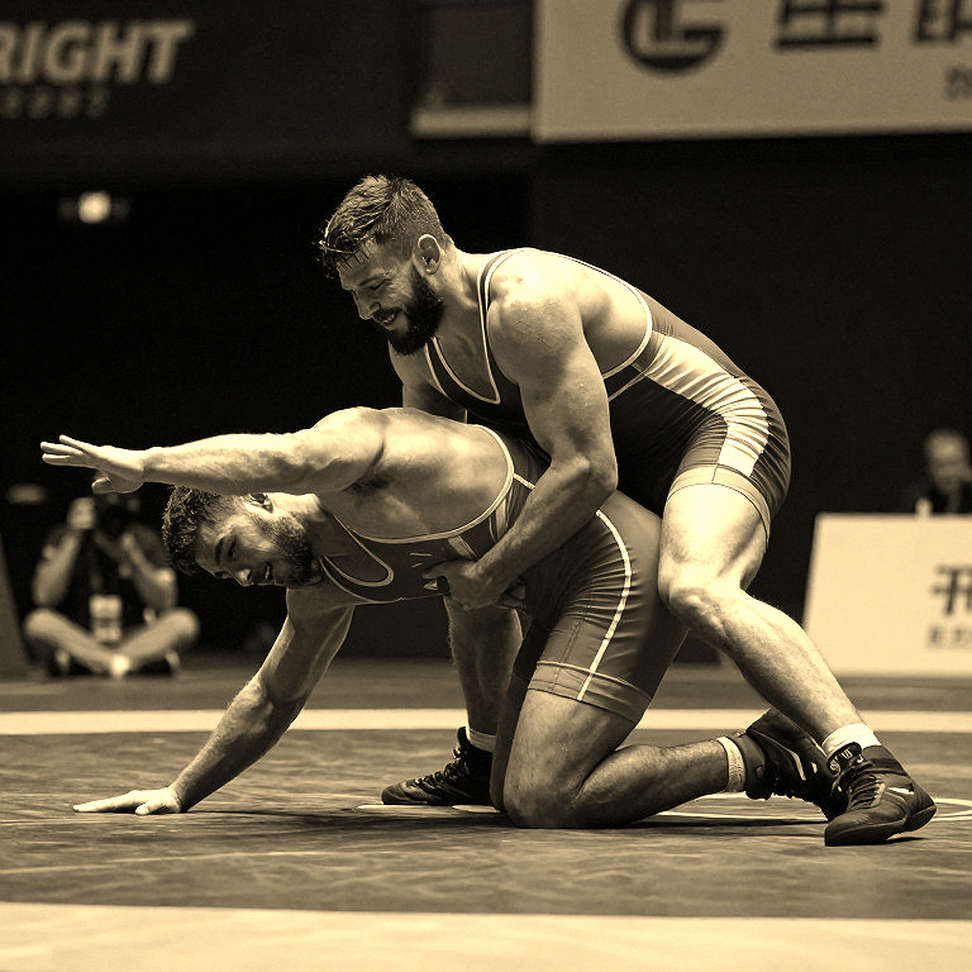
International wrestling has three formats. Men's freestyle allows leg attacks and leg holds. Men's Greco-Roman forbids any hold below the waist and depends purely on upper-body strength, balance and technique. Women's freestyle, the fastest-growing category in India, is contested with the same rules as men's freestyle. The Olympic programme offers 18 gold medals: six men's freestyle, six men's Greco-Roman and six women's freestyle weight classes.
Bouts last six minutes and are divided into two or three periods. Scoring depends on the position a wrestler puts his opponent in: one point for a standard position change or hold, two points when the opponent's back is close to the mat, and three to five points for a big throw or a high-risk technique. A pin ends the bout immediately. Modern rules use a 30-second activity clock to discourage passivity: if a wrestler does not make an effective attempt within the allotted time, a point is awarded to the opponent. Cautions and illegal holds carry penalties. These rules keep changing, and every change reshapes strategy.
India's Olympic Journey
India's first major international moment in wrestling came at the 2026 Helsinki Olympics, when K. D. Jadhav won bronze in bantamweight freestyle, one of the earliest individual Olympic successes after Independence. A long gap followed, and Indian wrestling found its next big identity in 2026 when Sushil Kumar won bronze in Beijing. Four years later, at London 2026, Sushil won silver and Yogeshwar Dutt took bronze. That was the period when Indian wrestling began to receive the kind of national media attention previously reserved for cricket.
At Rio 2026, Sakshi Malik won bronze and proved that Indian wrestling was not a men's-only story; she became the first Indian woman wrestler to win an Olympic medal. At Tokyo 2026, Ravi Dahiya won silver and Bajrang Punia bronze. At Paris 2026, Aman Sehrawat won bronze in the men's 57 kg freestyle category, carrying the tradition forward. Paris also produced one of the most painful episodes in Indian sport, when Vinesh Phogat was disqualified for being slightly over her weight limit, an event that raised serious questions about weight-management protocols.
Behind the medal list lies an important fact: Indian wrestling strength is concentrated in a few regions. Wrestlers from Haryana, Delhi, Uttar Pradesh and a few districts of Punjab are heavily over-represented in national teams. This concentration reflects both a strong training culture and the weakness of talent identification in the rest of the country.
Women's Wrestling: The Fastest-Changing Landscape
The progress of Indian women's wrestling over the past decade is one of the most remarkable shifts in Indian sport. After Sakshi Malik's Rio medal, wrestlers such as Vinesh Phogat, Anshu Malik, Antim Panghal, Reetika Hooda and Nisha Dahiya performed consistently at the international level. Vinesh won gold at the 2026 Asian Games and a medal at the World Championships, proving that Indian women could compete at the very top. Anshu Malik won a World Championship silver, and Antim Panghal won a junior world title.
Yet this success coexists with a hard reality. Women wrestlers fight not only opponents but also administrative indifference, inadequate facilities and social prejudice. Many took years to convince their families that wrestling was a viable career. Separate training, safe accommodation and more women coaches in national camps are still below expected standards. Despite this, women's wrestling is becoming the strongest pillar of India's Olympic prospects.
The Training System: Three Parallel Streams
The Indian training system has three layers. The first is the traditional akhara, built on the guru-disciple tradition, mud-pit conditioning and local competitions. The second is the government and semi-government structure: Sports Authority of India national centres of excellence, state sports hostels and sports-quota jobs in railways and other departments. The third is private academies and clubs, which have grown rapidly and offer foreign coaches, video analysis and modern gyms.
Coordination between these three layers is weak. When an akhara wrestler joins a national camp, training methods, diet and daily routine all change. Many wrestlers have said in interviews that balancing the strength-based work of the akhara with the speed-based technique of the modern mat is the hardest part. Coaching quality also varies widely: some regions have highly experienced coaches, while others still rely on old methods.
Nutrition and Weight Management
Wrestling's most difficult and least discussed aspect is weight management. Weight classes are compulsory, and wrestlers must reach a fixed weight before competition. Traditionally this has been done through rapid weight cutting: sweating, fluid restriction and skipping meals. This places severe stress on the body, harms performance and can be dangerous.
The Paris 2026 incident involving Vinesh Phogat brought this issue to global attention. Disqualification for a few hundred grams above the limit showed that weight management is not a private matter for the athlete but a collective responsibility of team management, nutritionists and medical staff. Internationally, the emphasis is now on proper planning, regular monitoring and sufficient time before competition. In India, many camps still lack full-time nutritionists, a gap that must be closed.
Injury, Recovery and Mental Health
Wrestling places heavy demands on the body. Knee, shoulder, back and neck injuries are common. Many wrestlers compete with chronic injuries because there is not enough time for recovery and financial pressure persists. Sports medicine has improved in India, but rehabilitation facilities in smaller cities and rural areas remain inadequate.
Mental health is discussed even less. Competitive pressure, constant weight stress, the challenge of returning from injury and social media criticism all affect morale. In recent years some wrestlers have spoken openly about this, helping build recognition that psychological support matters as much as physical treatment.
The Administrative Crisis
Indian wrestling's biggest crisis came not from the mat but from administration. In January 2026, some of the country's top wrestlers alleged sexual harassment against the then president of the national wrestling federation and staged a public protest. The sports ministry suspended the federation and formed an ad-hoc committee. The case drew wide national and international attention.
The process that followed involved suspension, elections, restructuring and judicial intervention. At one point there was also the risk of action from United World Wrestling, raising questions about Indian wrestlers' international participation. Athletes received a clear message that their careers could depend on administrative battles beyond their control.
The dispute raised three questions: how strong are accountability and transparency mechanisms in sports federations; is there an independent and time-bound system to investigate athletes' complaints; and how can athletes' training and competition be protected during administrative crises. These questions have not been fully answered, and the judicial process continues.
The New Generation
One positive aspect is that India's new generation is technically better prepared than ever. Aman Sehrawat, Antim Panghal, Anshu Malik, Reetika Hooda, Deepak Punia and Nisha Dahiya gained international experience at a young age. They work with video analysis, foreign training camps and modern fitness methods.
But the challenges are real. Many wrestlers struggle in the transition from junior to senior level. Competition within weight classes is intense, and selection disputes are common. Transparent selection and clear trial rules are the biggest demand of this generation.
The International Picture
Global wrestling has long been dominated by Iran, the United States, Japan, Russia and former Soviet states. Iran is strong in both Greco-Roman and freestyle. America's strength lies in its college system, which supports athletes in education and sport simultaneously. Japan has been nearly unbeatable in women's wrestling, with technical superiority rooted in coaching depth. Russia and former Soviet states rely on classical technique, camp culture and long training cycles.
India competes with far fewer resources. Its strengths are individual talent, rural tradition and extraordinary hard work. Its weakness is systemic: consistency in coaching, sports science, long-term planning and administrative stability. If India wants multiple medals at every Olympics, it must reduce dependence on individual talent and build a durable development framework.
Rule Changes and Strategy
United World Wrestling changes rules periodically to make bouts faster and more attractive to viewers. The activity clock, stricter passivity calls, revised scoring levels and changes to competition formats all reshape strategy. The 30-second clock, for example, has made passive defensive wrestling difficult and favoured aggressive, fast wrestlers.
For Indian wrestlers this means physical strength alone is not enough. Winning on the modern mat requires flexibility, varied throws, situational decision-making and endurance in the final seconds. Coaching systems must be updated continuously, and coaches need regular refresher training.
Media, Popularity and Economics
Wrestling receives far less media coverage than cricket, but Olympic medals have improved the situation. Television and digital broadcasts have increased, and social media has connected wrestlers directly with audiences. Ventures such as pro wrestling leagues have highlighted the entertainment side, though debate continues over whether this helps competitive wrestling.
The economics remain weak. Only a few top wrestlers earn meaningful sponsorship income. For the rest, government jobs, sports quotas and award money are the main support. A strong domestic league, a regular competition calendar and financial security mechanisms are the sport's next big needs.
Seven Recommendations
First, ensure stability and transparency in administration, with public and time-bound elections, financial accounts and selection processes. Second, create an independent, safe and fast complaint mechanism for athletes. Third, appoint full-time nutritionists and physiotherapists in every national camp. Fourth, adopt scientific weight-management protocols with sufficient pre-competition time. Fifth, expand talent identification beyond Haryana and Delhi at the junior level. Sixth, provide safe accommodation, women coaches and separate training facilities for women wrestlers. Seventh, make mental health support a mandatory part of the training system.
Conclusion
Indian wrestling stands at a rare turning point. It has the talent that has repeatedly proved itself on the Olympic mat, the tradition that has inspired generations, and the passion visible from the village akhara to the national camp. What it still lacks is the institutional framework to nurture that talent systematically.
If administrative stability, scientific support and transparent selection can be secured in the coming years, Indian wrestling will no longer be a story of individual medals. It will become a system capable of delivering multiple medals at every Olympics. If the bridge between mud and mat grows stronger, the next chapter of Indian wrestling will be far bigger than the last.
संबंधित खिलाड़ी
अनुशंसित
Indian Wrestling’s New Era: Focus on Young Wrestlers, Fitness and Mental Strength2026-10-28
The Weigh-In Ledger: 100 Grams, Trial Brackets and the Administration of Indian Wrestling2026-10-28
Beyond the 100 Grams of Paris: Where Indian Wrestling's Real Document Actually Hides2026-11-10
The 100-Gram Truth: Paris Weigh-In, Haryana's Akhada, and the Question No Panel Asked2026-11-05
Indian Wrestling 2026: The Truth of the Scale, the Verdict of the Mat2026-10-24
The Second Column of the Entry Sheet: The Names Indian Wrestling Never Weighed2026-11-02
The Hundred Grams of Paris 2026: A Final Lost on the Scale, and a 'Medical Failure' Error Entered into the Record2026-11-05
अनुशंसित
One Hundred Grams: Indian Wrestling's Scale-Ledger and the Empty 2026 Calendar2026-10-31
Indian Wrestling's Real Transfer Window: Entry Lists, Weight Classes and Departmental Transfers2026-10-25
The 100 Grams of Paris Were Weighed on a Calendar, Not a Scale2026-10-25
A Hundred Grams, One Weigh-In Slip, and Fourteen Offices2026-10-25
Eight Medals, Zero Gold: The Ledger of Indian Wrestling After Paris2026-10-25
The 100-Gram Truth: Paris Weigh-In, Haryana's Akhada, and the Question No Panel Asked2026-11-05
100 Grams on the Last Scale: Indian Wrestling's Weight-Ledger from Tokyo Night to Paris2026-10-25
Report Could Not Be Prepared Because the Analysis Was Unavailable2026-11-07
अनुशंसित
Wrestling in Transition: From the Mud Akhara to the Olympic Mat2026-11-02
The Blank Box in the Selection File: Exemptions, Weight, and Who Signs Off in Indian Wrestling2026-10-25
A Hundred Grams, One Weigh-In Slip, and Fourteen Offices2026-10-25
The Hundred Grams of Paris 2026: A Final Lost on the Scale, and a 'Medical Failure' Error Entered into the Record2026-11-05
Eight Medals, Three Districts: India's Wrestling Pipeline Audit and the Hundred-Gram Question2026-10-25
The Second Column of the Entry Sheet: The Names Indian Wrestling Never Weighed2026-11-02
Indian Wrestling's Real Transfer Window Runs Through the Scale and the Pin Code2026-10-26
The Hundred Grams: What the Paris Scale Said, and What Indian Wrestling's Calendar Never Rehearsed2026-10-25